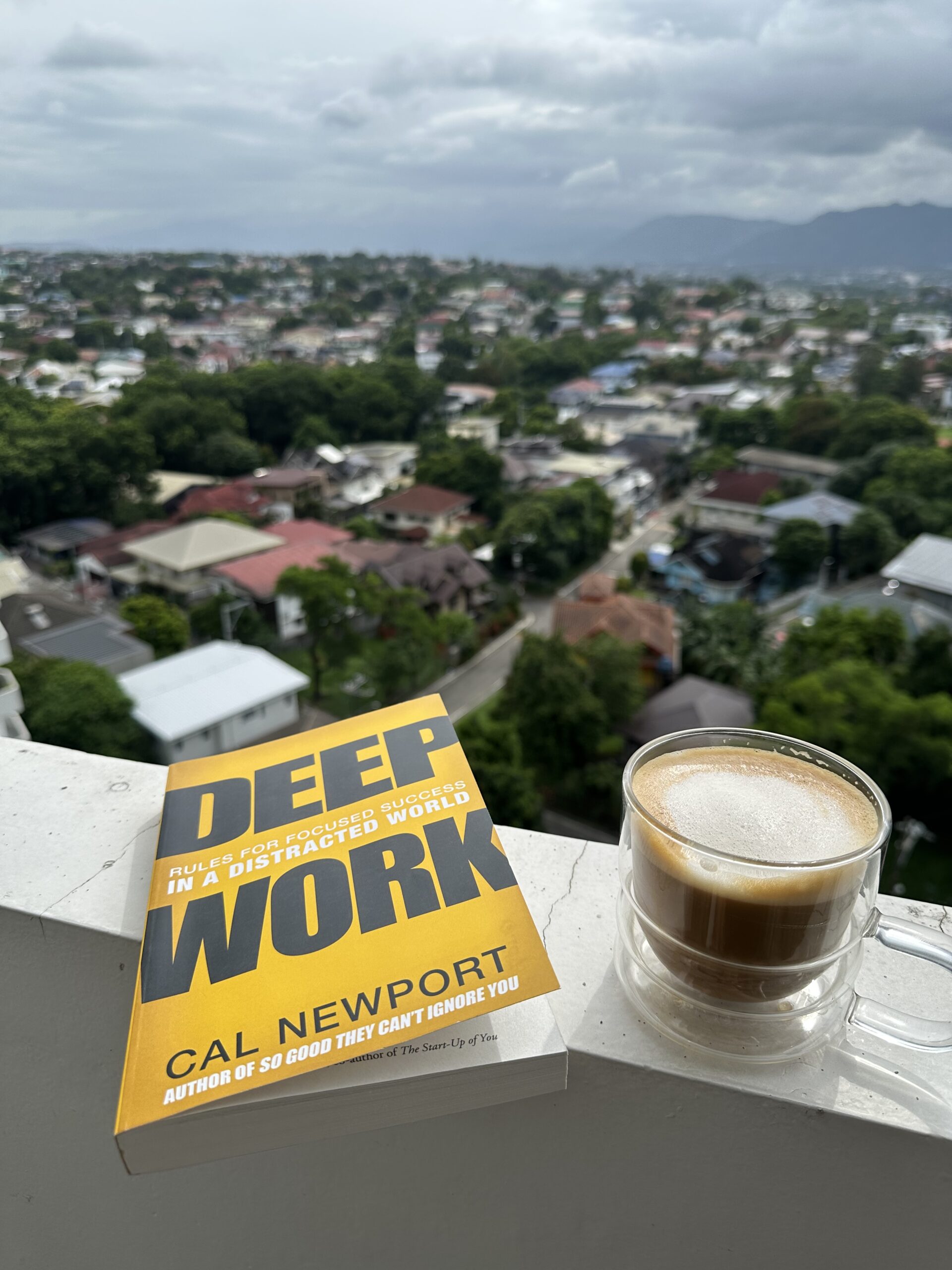
While walking aimlessly one day at a bookstore, a book’s title caught my attention: “Deep Work”. The book is by Cal Newport, a professor at Georgetown university (USA). I thought this was really something worth reading during my ‘free’ time (aside from the academic papers I am supposed to be always reading). It is basically a book about how one should spend time in the ‘flow state’ or one engaging in deep work to be able to accomplish a high quality task.
Deep work is important, rare and valuable.
Newport defined deep work as “the ability of one to do professional activities in a state of distraction-free concentration”. He argued that that this allows one to push cognitive capabilities to their limit. According to him, deep work creates new value, improves one’s skills and are hard to replicate. When one needs to produce high quality output, he or she needs to do it in a distraction-free environment where one can have an uninterrupted concentration. The opposite of deep work is shallow work. He defined it as a non-cognitively demanding logistical-style task, and is usually done while distracted. I thought a good example of this is something one can do routinarily (even using phones occasionally during this task).
In the early chapters, he provided examples that showed how influential people did deep work. One of the prominent thinkers he mentioned was the eminent psychologist Carl Jung, who literally ‘locked himself’ in a tower near Lake Zurich to work on something for extended periods, without interruptions and disruptions. He mentioned other successful people who employed this way of approaching professional activities. Many more examples and results of studies were also given. For example, employees that constantly check emails were reported to be less productive (due to distraction, i.e., cannot do deep work) than those who schedule checking and replying to emails (e.g., once in the morning and once in the afternoon).
Two core abilities for thriving
According to Newport, for someone to thrive in today’s new economy, they must be able to (1) quickly master hard things and (2) produce at an elite level (in terms of both quality and speed).
Learning (especially hard things) is an act of deep work. However, this is not the only thing we need to do, we also have to produce at an elite level. One key thing Newport emphasized is that no matter how skilled (or knowledgeable you are), if you don’t produce, you won’t thrive. This somehow struck me– something I thought needs some action, if I want to thrive in this ‘new economy’.
[this is still a work in progress]